
What started as food poisoning ended in an emergency appendectomy. Here’s exactly what the surgery and hospital stay cost me in Mexico.
Saturday night was like any other fun night in Puerto Vallarta. We went to a BBQ, met some new people, had a couple of drinks, came home and went to bed.
At 2 am I woke up with stomach pain. Damnit. I knew I shouldn’t have eaten that dip. It was probably sitting out too long. A few moments later, I was sprinting to the bathroom.
Oh great, food poisoning! Or so I thought. I mean, we’ve been living abroad since 2013, eating street food from questionable places on the regular. I don’t know anyone who’s lived this life and hasn’t. I’ve got a sensitive stomach, and I’ve taken Imodium in nearly every country I’ve ever visited. Food poisoning doesn’t scare me. I just know it sucks and was getting ready for a long night.
Which it was. Every hour, I was throwing up in a bucket on my lap while sitting on the toilet, or just lying on the cold bathroom tiles, waiting for the next round.
The one thing I noticed and found so strange was the way my stomach hurt all night long. From the ribs down to my pubic bone, a solid mass of pain. Usually with digestive things, the pain comes and goes, and you feel better after throwing up. But not this time. I kept a heating pad on my tummy all night and still no relief. Something about this felt different from every other time I’d been sick.
Then I started throwing up bile, and that’s when I knew this wasn’t food poisoning. Mark had already called our BBQ host to check whether anyone else had gotten sick. No one had.
Going to the Emergency Room in Puerto Vallarta
At about 10 am, Mark suggested we go to the hospital, but I’m pretty horrible about going to the doc or to the hospital for that matter. I just want to ride it out in my own home. But two hours later, I walked out of our bedroom fully dressed, purse in hand, and told him it was time to go to the ER.
Mark almost spat coffee through his nose. He was shocked. But he drove me straight to CMQ, a private hospital in Puerto Vallarta’s Romantic Zone, one of the hospitals on our insurance’s approved list. We had just changed to Mapfre, a Mexican health insurance company, and this was our first experience with it and with CMQ. And my first real look at what an appendectomy actually costs in Mexico when you need one immediately.
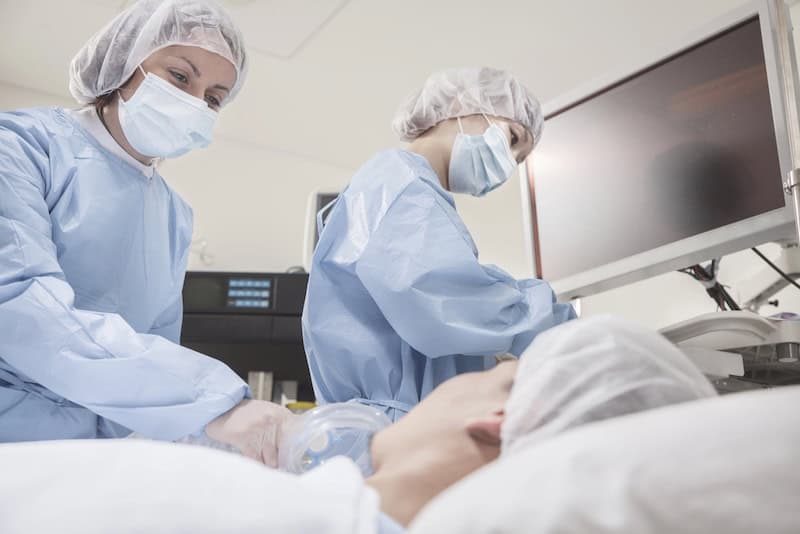
I walked into the Emergency Room while Mark was parking and described what was happening. I was the only person in there. The intake woman got some basic info and sent me in to see the doc. He was kind, spoke perfect English, and was quite young (36 years old, I asked). He palpated my stomach, and when he got to my right side, I howled with pain. That was enough for him. He wanted a CT scan of my abdomen STAT!
That’s when the front desk lady asked for a deposit, or actually it’s a hold of funds. We’d figured that was coming. The thing about Mexican hospitals is that they won’t let you leave until the bills are paid in full. So, if you don’t have the funds, they’ll keep you and rack up a higher bill, but you aren’t going anywhere. No money, no discharge.
When they requested 80,000 pesos (roughly $4600), we were stunned. Was it really just for a CT scan? Mark handed over his card because without it, I wasn’t going to get a CT scan at all. Then he immediately called our insurance agent, who also agreed it was absurd and said he would investigate.
The Diagnosis: It Was My Appendix
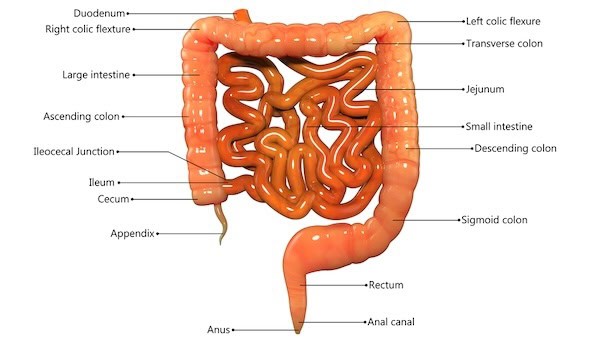
Off I went for the scan, and within about 30 minutes I had the results. The doctor in the emergency room was so confident that he also ordered an EKG and chest X-ray to prepare me for an appendectomy.
Sure enough, my appendix was ready to blow. I never once suspected it was my appendix. As a Jew, I diagnose myself with the confidence of someone who went to med school, despite never having gone to med school. I ran through every possibility. Kidney stone? Gall bladder? My liver finally staging a revolt against my fondness for vodka?
Never did I think it was my appendix. What’s that little wormy-looking thing do anyway?
Turns out its whole purpose is to occasionally try to kill you.
The doc told me he called a surgeon who was on the way. Surgery? Now? Isn’t there some medicine, some strong antibiotic to make this better? Surely that’s a bit extreme? Even for a slight hypochondriac like myself. He shook his head. He wasn’t budging.
Meeting My Surgeon (In a Spain Futbal/Soccer Jersey)

Then the surgeon walked in wearing a Spain futbal jersey.
For a second, I thought I’d hallucinated a random soccer fan wandering into my hospital room. He had such a baby face. This could not be my surgeon. He was a 6-foot-plus man with the mannerisms of the Pillsbury dough boy. I was certain that if I pushed his belly button, he’d giggle just like him.
See, my plan for the day was to watch the World Cup final: Spain vs. Argentina. Coincidentally, that was my surgeon’s idea too. So, when he mentioned that, since I had water and Pepto-Bismol in my stomach (as seen on the CT scan), he couldn’t perform the surgery for a few hours, I immediately said, “Doc, please tell me you’re not going to get drunk watching the futbal game and then come and perform my surgery? Because that is exactly what I want to be doing, minus the surgery part.” He laughed and just said, “No, of course not.”
I grilled him about how many appendectomies he’d done. Which felt fair, considering I’d just met the man, and he wasn’t even in scrubs yet. He was clearly on call, but that doesn’t mean they are waiting around at the hospital for some action.
I made him promise to let me see my appendix after surgery and to take pictures while he was in there. Not because I didn’t trust him, just because I was fascinated by the whole scenario.
Surgery and Recovery in a Mexican Hospital
While waiting for the surgery, they wheeled me to my room upstairs, and this is where my Mexican hospital experience really started to feel different from anything back home. I still hadn’t seen another patient anywhere in the building. Not even another doctor, like this was my own private hospital. I actually asked the nurse if I was the only patient because I didn’t see or hear anyone while I was there. She said she had other patients, but I have my doubts.
They put me on painkillers and anti-nausea pills so the vomiting stopped, along with whatever apocalypse was happening at the other end. I actually felt human-ish again. Not great, but no longer dying.
Around 5 pm, after Spain won, it was my turn. I was quite scared and a bit teary-eyed when the anesthesiologist came in. I told him I was scared and that he better make sure I feel nothing, or I’ll find him after the surgery and perform a surgery on him. 🤣. He promised I’d feel nothing. And I didn’t.
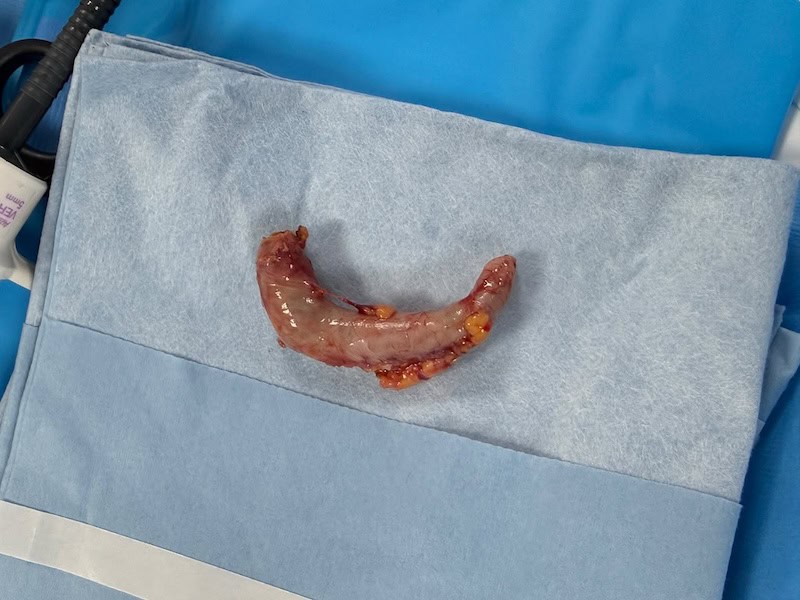
The next thing I knew, I was back in my room. And there was a little jar waiting for me with my appendix in it, looking like an octopus tentacle. It’s officially the least Instagrammable thing I’ve ever asked to photograph. It was pretty nasty and bloated.
Nurses came in about every two hours to check on me and give me new IV fluids, antibiotics, and pain meds. I spent most of my hours drifting in and out, watching reruns of NCIS and the new version of Hawaii Five-O in Spanish.
I couldn’t move or go to the bathroom by myself, so I had a nurse button that I used whenever I needed help because I couldn’t even sit up by myself or change the position of my pillow. They were super attentive and endlessly patient with me.
I don’t know if they spoke English because I was trying to speak Spanish the whole time. I didn’t even use Google Translate, which probably would have been smart, and if I needed something serious, I would have.
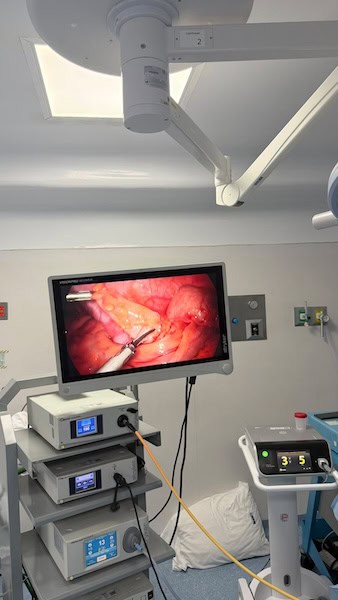
The next morning, the doctor walked me through photos from the surgery: the inside of my abdomen, the laser making the incision, and finally my appendix itself, which I immediately declared looked like a gross, bloated salchicha, a sausage. I’ll never look at a hot dog (or octopus) the same way.
Going Home: Discharge and Timing
When he told me I could leave the hospital, I must have looked uneasy. Doc, you just cut out an organ. Are you sure I can leave so soon? But because the infection was contained in my appendix, which was in a cup by my bedside, I didn’t need to stay any longer. If it had burst, then I would probably be in the hospital for four or five days trying to manage a messy infection.
Gracias a Dios, I could go home.
It was around noon, and he said it would take about four or five hours to get all the paperwork ready for my release. I thought it was odd since they were already holding our money, and I’m still convinced I was the only person in the entire hospital.
I believe the issue was that my insurance wouldn’t cover the costs if I were in the hospital under 24 hours, so right at 5:00, when I went in for surgery, they had the paperwork ready. I have a feeling it was all to make sure the insurance would cover the surgery.
What My Emergency Appendectomy Cost in Mexico
Our final portion of the bill came to 59,000 pesos (roughly $3,400 USD). Our deductible was 40,000 pesos ($2300), and the remaining 19k was a 10% copay. Our agent said they billed Mapfre 191,000 pesos ($11,000 USD). That’s why our bill was 59,000.
I couldn’t even walk into a hospital, let alone take an ambulance into a hospital, for that much money in America. Yet, for many locals, this could be crippling.
Since they held 80,000 pesos, but the charge was 59,000 pesos, they just released the hold and charged the 59,000. It was all pretty seamless.
What I’ve Learned from Two Surgeries in Mexico
If there’s one thing I’d tell anyone new to healthcare for expats in Mexico, it’s that if you don’t ask specific questions, nobody volunteers the answers.
I have no complaints about the care that I got at all. The actual care was great.
However, I have two gripes with my healthcare experiences in Puerto Vallarta based on my appendectomy and my knee surgery.
Ask More Questions Before Surgery
Not because they’re withholding information, but because they perform so many of these procedures that it probably doesn’t occur to them that it’s worth explaining. What’s everyday and basic for them isn’t basic for us. And I never asked.
Case in point: with my knee surgery, I never asked about how I would be put under. I assumed it would be through my IV. But nope, it was a spinal block, which I was not mentally prepared for. AT ALL. I lost my sh!t!
Prepare for Thin Aftercare Instructions
For my appendectomy, the surgeon told me to come back and see him in seven days to get the stitches removed. I was handed a single sheet of paper with the four meds, instructions on how to take them, and sent on my way. I didn’t know when to start. I hadn’t left the hospital until 5 pm. Had I already taken that night’s dose?
The surgeon was supposed to give me his WhatsApp to contact him. He forgot. Thankfully, I just looked online and found his private number on a site called Doctoralia. Ever since, he got back to me right away and has been super attentive. One of the great perks of healthcare in Mexico is that you can often get your doctor’s or surgeon’s private phone number, a huge benefit of the system here. More amazingly, they respond personally.
My biggest lesson is that if you have the time when you’re having some sort of surgery, do your research and have your list of questions ready. Ask an AI what questions you should be asking before your specific surgery, so you’re not caught off guard the way I was. Because you don’t know what you don’t know.
Appendix: Gone. Perspective: Gained.
If my appendix had to pick a place to detonate, I’m weirdly glad it picked here. Same-day surgery, a doctor who actually texts back, and a final bill that wouldn’t have covered a night in an American ER waiting room. This isn’t the “getting sick abroad” horror story people expect when I tell them we live in Mexico full-time.
I’m back to eating that dip, for the record. Cautiously. And yes, I still have the jar.
Even if you don’t live here, the moral of this story is to A: listen to your body, and B: have some sort of medical insurance. Even if you are just traveling. This could have happened to me in any country. Without insurance, we would have paid an exorbitant amount of money for this. Safety Wing offers all types of insurance for travelers. Check out their rates below. It’s worth having!
Faq’s About Getting an Emergency Appendectomy in Mexico
How much does an emergency appendectomy cost in Mexico?
Ours came to $3,400 USD out of pocket with insurance, against a full hospital bill of about $110,000 pesos before coverage.
Do Mexican hospitals require payment before surgery?
Private hospitals typically want a deposit or hold on funds before major procedures, and you can’t be discharged until the bill is settled.
What should you bring to a Mexican hospital in an emergency?
A credit card for the deposit, your insurance info, and patience, since paperwork and payment holds move slower than the actual medical care does. It might be a good idea to keep a credit card with a high available balance just for emergencies. I know horror stories where they keep people for weeks until the patient can find a way to get the money to cover the total expense.
Is it safe to get surgery in Mexico as an expat?
Between the English-speaking doctor, the same-day CT scan, and a surgeon on call within the hour, this experience felt faster and more responsive than anything comparable back in the US.
So, I hope this post didn’t horrify you. It was meant to assure you that having surgery in a Mexican hospital is just as scary as having surgery in an American hospital, maybe less so. Surgeries are scary, but I felt like I was in great hands and I’m glad it’s over with.
Have you had surgery in another country? Tell me about it in the comments below.




Hi Kirsten! Happy you are completely recovered!! Moving to Vallarta in 3 weeks, would love to connect but also your insurance contact’s info would be super helpful, please. Thank you 🙂
Hi Mike! Such exciting times for you! Sure, Angel’s WhatsApp info is +529991291140. He can help with insurance. See you soon,
Kirsten
I’m glad you are OK Kirsten. I had a hernia operation in Vietnam in a foreigners hospital in Hanoi. Operation went very well, mostly English speaking doctor, over night stay. Cost about 60 million dong (2,300USD). My share was a copay. I have TriCare for Life with the military and it works great all over the world. While MediCare wont cover outside USA, TriCare pays almost the same (usually more) everywhere.
I had another hernia surgery (other side) in the States about 15 years earlier and it was more expensive. My next planned operation is a catarac surgery with lens replacement in Turkey this fall. About half the price in the US. MediCare will only pay for the basic and I want the deluxe lens (like Mark). They have told me it is 1/2 the price of USA.
Wow! Eric it’s good to know the military care take such good care of you. They should! At the very least! You are going to be so happy with the new eyeballs! You’ll be bionic too! Take care and happy travels! Hi to Larissa!
Happy to hear that your surgery went well.
It is surprising to see the commonalities between Mexico and a private hospital in Penang. However, with the medical insurance I have I don’t have to pay anything, as long as you have been admitted for at least one night.
Me too, Jeroen. The medical systems def are similar in many ways.
Wow! Classic symptoms with an excellent outcome – medically and financially!
I never travel without insurance, it’s just not worth the risk of getting stuck with a huge bill. I keep a Facebook post of people who have medical emergencies in Thailand without insurance and have to start a fundraiser to pay.
I’ve still got all of my organs but if they start getting yanked, every one is getting its own special jar like yours!
Ha, Michael, I hope you keep all your organs, but a shelf above the fireplace would be a great place to keep them. Unless you get them bronzed like baby shoes!
Wow! Thank you for sharing your story. So glad you are okay and that you felt you got good care overall. What an experience!
Hi Laura Louise, It was crazy. It all happened so fast once I got to the hospital. Glad its all behind me now!
I probably shouldn’t have read this post over breakfast. 😂 But I’m pleased with your happy outcome.
Ooof, 🤮 sorry about that! But thanks for reading!
I enjoyed your story – you are such a good writer!
In the last 12 years, I have travelled to 62 countries – never with insurance (I’m Canadian – we don’t pay for that!). In February, I developed a severe case of pnuemonia on a cruise ship headed to Phuket from Sri Lanka. One night care in the cruise ship – US$6k. Ambulance and emergency care in Phuket, including 2 specialist followup visits – US$1k. 1st class+ care in a hospital that rivalled a Four Seasons hotel. I guess I paid 12 years of insurance all at once, but the care was awsome.
Back to Europe in the Fall …
Holy moly, David! You are lucky you were in Thailand! The healthcare there is some of the best in the world, and affordable to boot! So, will you get travel health insurance next time you go somewhere?